
Do Books Matter?
Choosing to change the future

In this age of book banning, AI technology and doom-scrolling, are reading and writing fighting a losing battle? How important are books to you, and would you be willing to risk your life to save your collection?
Over centuries, monks, scholars, philosophers, scientists and writers have preserved knowledge and information on printed pages. Although early books were not available to the general public, those with education recognized the value of collecting and conserving details of the wisdom of their times for future generations.
Indeed, in 1597, Sir Francis Bacon recognized this with his statement “knowledge is power” in his publication Meditationes Sacrae. Authoritarian regimes acknowledge the power knowledge wields by defunding universities and cultural centres, firing scientists and journalists, gutting media and libraries and banning books.
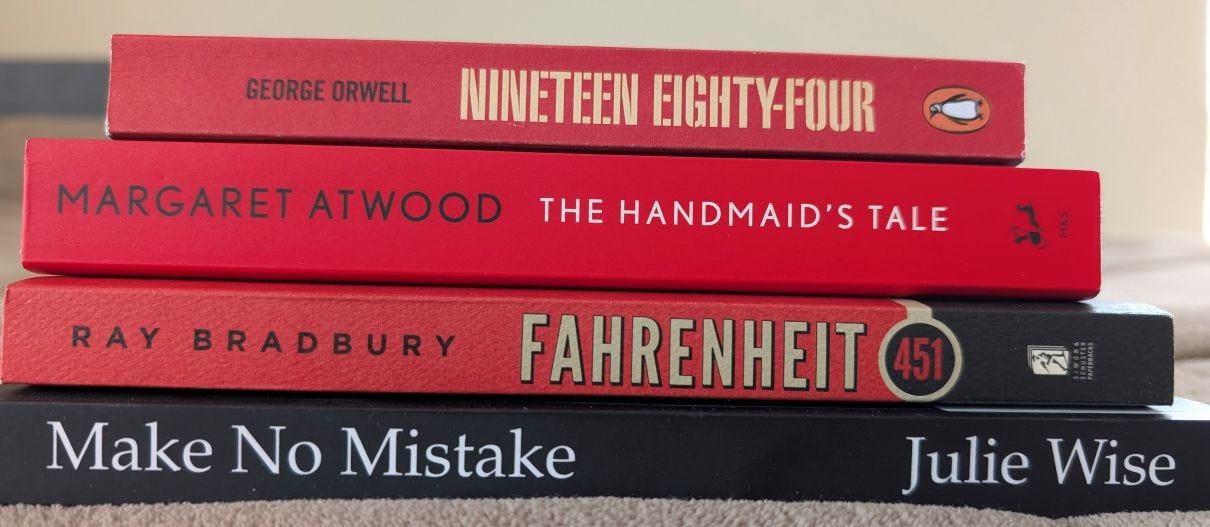
In a recent talk I gave at a local library, I examined the common themes in four dystopian novels – 1984, Fahrenheit 451, The Handmaid’s Tale and Make No Mistake. In each one, the regime bans (or burns) books in order to control citizens. If we don’t read, we don’t question. If we don’t question, we can be manipulated and controlled.
Fortunately, there are many examples over the years of people doing everything they can to protect books and preserve knowledge. When Baghdad fell to a Mongol invasion in 1258, 500 years of manuscripts on mathematics, astronomy, medicine and philosophy were at risk. One man smuggled 400,000 manuscripts to safety before the seige. Scholars fled with texts hidden in their clothes.
In 1728, the city of Copenhagen burned and destroyed the university library, including the only written copies of Iceland’s medieval sagas. Instead of evacuating, an Icelandic scholar managed to save 1600 handwritten manuscripts although he lost his own writings, books and house to the fire.
Between 1940-43, Jewish rabbis, writers, teachers and journalists documented everything they could while trapped in the Warsaw Ghetto. When deportations began, they sealed the documents in milk cans and metal boxes and buried them under the streets. After WWII was over, the few survivors led searchers to the sites where 35,000 pages were recovered.
In 1966, the Arno River flooded in Florence, threatening 4 million manuscripts. Ten thousand volunteers showed up from around the world, passing pages and books hand to hand to safety. They became known as Gli Angeli del Fango, the Mud Angels.
Where’s the glimmer in all of this? Aside from these incredible examples of people risking their lives to save books, let me share a current story about the impact of books.
In Jefferson County, Kentucky, a school district has banned cell phones, smart watches and other digital devices during the school day. The result? Students are checking out library books in record numbers.
In the first 17 days of the 2025-26 school year, at one high school alone, students checked out more that 1200 books, nearly half the total for the previous year. Students aren’t just reading books; they are talking about them with each other, checking out board games, card games and colouring books. They have put down their devices and are building connections with books and with each other.
Doesn’t this give you hope for the future?
And as long as we stay awake and aware, we can resist.
Yes, it does give us hope! Books and board games!